Circuit Breakers for AI Agent Pipelines: Engineering Graceful Degradation When Models Fail
Your agent pipeline calls four models in sequence. The third one starts returning garbage. Without circuit breakers, the garbage propagates downstream, corrupts state, and your users see the failure as a product bug -- not an infrastructure incident.
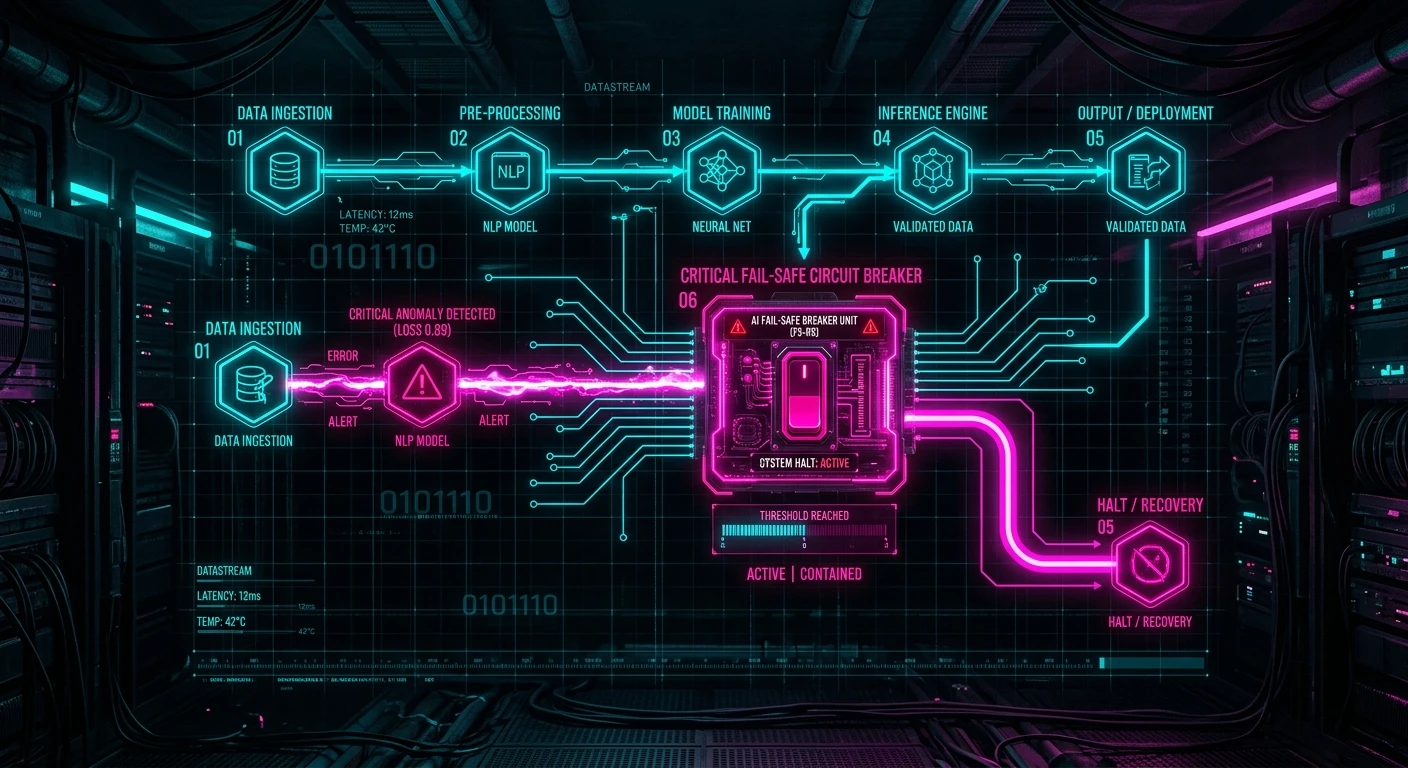
When the Model Fails, Everything Downstream Burns
Microservices engineers learned the circuit breaker pattern fifteen years ago. When a downstream service starts failing, you stop calling it -- you "open the circuit" -- instead of letting cascading failures bring down the entire system. Netflix popularized this with Hystrix. Every serious distributed system uses some variant today.
AI agent pipelines have the same problem, but worse. A failing model does not return a clean error code. It returns plausible-looking garbage. The downstream components -- other models, tool calls, state mutations -- consume that garbage as if it were valid input. By the time anyone notices, the corruption has propagated through the entire pipeline and the system state is inconsistent.
This is the fundamental difference between traditional service failures and model failures. A database that is down returns a connection error. A model that is degraded returns a confident, well-formatted, completely wrong response. Your existing health checks pass. Your existing error handling does nothing. The circuit stays closed while garbage flows through it.
Every team running multi-agent orchestration in production discovers this within weeks. The orchestrator routes work to agents. One agent's underlying model starts hallucinating due to a provider degradation. The orchestrator sees successful responses and routes more work. The hallucinated outputs feed into downstream agents. By the time quality metrics catch up, hundreds of tasks have been corrupted.
Why Traditional Circuit Breakers Are Not Enough
The classic circuit breaker pattern monitors error rates and response times. When errors exceed a threshold, the circuit opens and requests are short-circuited to a fallback. After a cooldown period, the circuit enters a half-open state and allows test requests through. If they succeed, the circuit closes.
This works when failures are binary -- the service is up or down. Model failures are not binary. They exist on a spectrum:
Hard failures: The API returns a 500, times out, or returns a rate limit error. Traditional circuit breakers handle these fine.
Soft failures: The API returns a 200 with valid JSON, but the content quality has degraded. The model is responding but not reasoning well -- shorter responses, more generic outputs, loss of instruction following, increased hallucination. These are invisible to HTTP-level monitoring.
Semantic failures: The model is performing well on surface metrics but has developed a systematic bias or blind spot, perhaps due to a provider-side model update or a change in the system prompt processing. Outputs look correct individually but produce subtly wrong results when evaluated against the actual task requirements.
Soft and semantic failures are where agent pipelines break catastrophically, because they are where traditional monitoring is blind. You need circuit breakers that understand output quality, not just HTTP status codes.
This is the same observability challenge that makes monitoring AI systems fundamentally different from traditional APM. The metrics that matter are semantic, not operational.
Quality-Aware Circuit Breaker Architecture
A quality-aware circuit breaker for AI agent pipelines has four components that extend the traditional pattern.
Output Validators
Every model call in your pipeline should have an output validator -- a lightweight check that evaluates whether the response meets minimum quality standards before passing it downstream.
For structured outputs, this is straightforward: schema validation, range checks, referential integrity. If your model is supposed to return a JSON object with specific fields and value constraints, validate that the output conforms. Structured output engineering gives you the foundation, but circuit breakers add the failure-mode response.
For unstructured outputs, validation requires heuristics: response length relative to prompt complexity (a one-sentence response to a complex analysis prompt is suspect), presence of expected structural elements (if you asked for a comparison, the output should contain comparative language), and consistency checks against the input (if the input mentions five items, the output should address all five).
The key design decision is speed. Output validators must add minimal latency because they run on every model call. Keep them deterministic -- no calling another model to validate the first one. That creates circular dependencies and doubles your failure surface.
Sliding Quality Windows
A single bad output is not a circuit-breaking event. Models are stochastic -- occasional low-quality outputs are expected. The circuit breaker tracks quality scores over a sliding window and trips when the trend crosses a threshold.
The window should be time-based, not count-based. A model that produces one bad output in a thousand is healthy. A model that produces one bad output per second for the last thirty seconds is degraded. Time-based windows catch degradation patterns that count-based windows miss when traffic varies.
Implementation: maintain a circular buffer of (timestamp, quality_score) tuples for each model endpoint. On each call, append the new score and evict entries outside the window. Compute the rolling average and compare against the threshold. If the average drops below threshold, open the circuit.
Fallback Strategies
When the circuit opens, you need a fallback. For AI agent pipelines, there are four viable strategies:
Model fallback: Route to an alternative model. This is the most common pattern and the reason every production pipeline should support model routing as an infrastructure concern. Your primary model is Claude Opus but the circuit breaker trips -- fall back to GPT-4o, or to a fine-tuned smaller model that handles the specific task acceptably if not optimally.
Cached response: For queries that are similar to recent successful queries, return a cached result. This works well for classification, extraction, and summarization tasks where inputs cluster. Semantic caching makes this viable even when inputs are not identical.
Degraded mode: Return a partial result with explicit quality flags. Instead of a full analysis, return the structured data extraction without the interpretive layer. Downstream components check the quality flags and adjust their processing accordingly. This is better than nothing and far better than garbage.
Queue and retry: For non-latency-sensitive tasks, park the request and retry when the circuit closes. This requires the pipeline to be asynchronous, which aligns with the broader shift toward event-driven architectures for AI agents.
Recovery Probes
When the circuit is open, you need to detect when the model recovers. The half-open state sends probe requests -- real requests with known-good inputs where you can validate the output quality -- through the degraded model. If probe results meet quality thresholds across multiple consecutive attempts, the circuit closes and traffic resumes.
Design probes carefully. They should be representative of your actual workload, not synthetic benchmarks. A model can pass a simple benchmark while still failing on your specific task distribution. Use a sample of recent successful requests as probe inputs and compare probe outputs against the cached successful outputs.
Implementation Patterns
Per-Step Circuit Breakers
The most granular approach: each model call in your pipeline has its own circuit breaker. Step 1 (extraction) has a breaker. Step 2 (reasoning) has a breaker. Step 3 (generation) has a breaker. Each can trip independently, and each has its own fallback.
This provides maximum isolation but adds operational complexity. You need per-step quality validators, per-step fallbacks, and per-step monitoring. For pipelines with more than five steps, this becomes unwieldy.
Pipeline-Level Circuit Breakers
The coarser approach: a single circuit breaker evaluates the final pipeline output. If end-to-end quality degrades, the entire pipeline falls back. This is simpler to operate but loses granularity -- you cannot tell which step is failing without additional investigation.
Hybrid: Critical-Step Breakers
The pragmatic approach: identify the 2-3 steps in your pipeline where failure has the highest blast radius and instrument those with individual circuit breakers. The remaining steps are covered by the pipeline-level breaker. This balances isolation with operational simplicity.
For most agent pipelines, the critical steps are: the initial input processing (garbage in, garbage out), any step that mutates external state (tool calls that write data), and the final output generation (what the user sees). Instrument these with per-step breakers. Cover everything else with the pipeline-level breaker.
The Testing Problem
Circuit breakers are notoriously hard to test because they activate under conditions you cannot easily reproduce in staging. Model degradation is not something you can trigger on demand -- it happens when providers have infrastructure issues, when model versions change silently, or when your input distribution drifts.
Three testing strategies that work:
Chaos engineering for models. Inject degraded responses at the model client level. Replace the real model response with outputs of varying quality -- truncated responses, off-topic responses, responses with subtle factual errors. Verify that your circuit breakers trip at the right thresholds and that fallbacks activate correctly.
Shadow evaluation. Run your quality validators on production traffic in shadow mode -- scoring every response but not tripping the breaker. Analyze the score distributions to calibrate your thresholds. What score separates "normal model stochasticity" from "model degradation"? You can only answer this with production data.
Historical replay. If you have experienced a model degradation event (and if you have been in production for more than a month, you have), replay that traffic through your circuit breaker and verify it would have tripped. This is your regression test for circuit breaker calibration.
This testing discipline is part of the broader eval-driven development practice that production AI systems require. You cannot ship what you cannot test, and you cannot test what you cannot simulate.
Operational Considerations
Circuit breakers add operational complexity. Here is what you need to operate them well.
Alerting on state transitions. Every circuit state change (closed to open, open to half-open, half-open to closed) should trigger an alert. These are signal-rich events. A circuit that oscillates between open and closed every few minutes indicates a borderline degradation that your thresholds are not handling cleanly.
Dashboard visibility. Each circuit breaker's current state, quality trend, and fallback utilization should be visible on your main operations dashboard. When an incident occurs, the first question is "which circuits are open?" If the answer requires digging through logs, your observability is insufficient.
Threshold tuning. Quality thresholds need regular calibration. As your tasks evolve, your input distributions shift, and your quality standards change, the thresholds that were right three months ago may be too tight (causing false trips) or too loose (missing real degradation). Build a monthly review into your operations cadence.
Fallback monitoring. Monitor fallback quality separately. If your fallback model is also degraded -- which happens more often than you would think, since provider-level issues can affect multiple models -- your circuit breaker is routing traffic from a bad path to another bad path. Alert when fallback quality drops below its own thresholds.
The Bigger Picture
Circuit breakers are one piece of the resilience engineering that production AI systems require. They work alongside idempotency patterns for safe retries, deterministic control planes for bounded agent behavior, and feature flags for model rollout for safe deployment.
The teams that ship reliable AI systems are not the ones with the best models. They are the ones with the best failure engineering. When your model works perfectly, anyone can build a good product. When your model degrades at 2 AM on a Saturday -- and it will -- circuit breakers are the difference between a graceful fallback that users barely notice and a cascading failure that takes your product offline.
Build the circuit breakers before you need them. The model degradation that justifies the investment is already on its way.
Founder & Principal Architect
Ready to explore AI for your organization?
Schedule a free consultation to discuss your AI goals and challenges.
Book Free Consultation