The Build Trap in Enterprise AI: Why 80% of Custom ML Projects Should Have Been Products
Enterprises are spending millions building custom AI solutions for problems that already have battle-tested products. The build instinct is a legacy from the pre-AI era — and it is burning engineering capacity at a rate that most organizations cannot sustain.
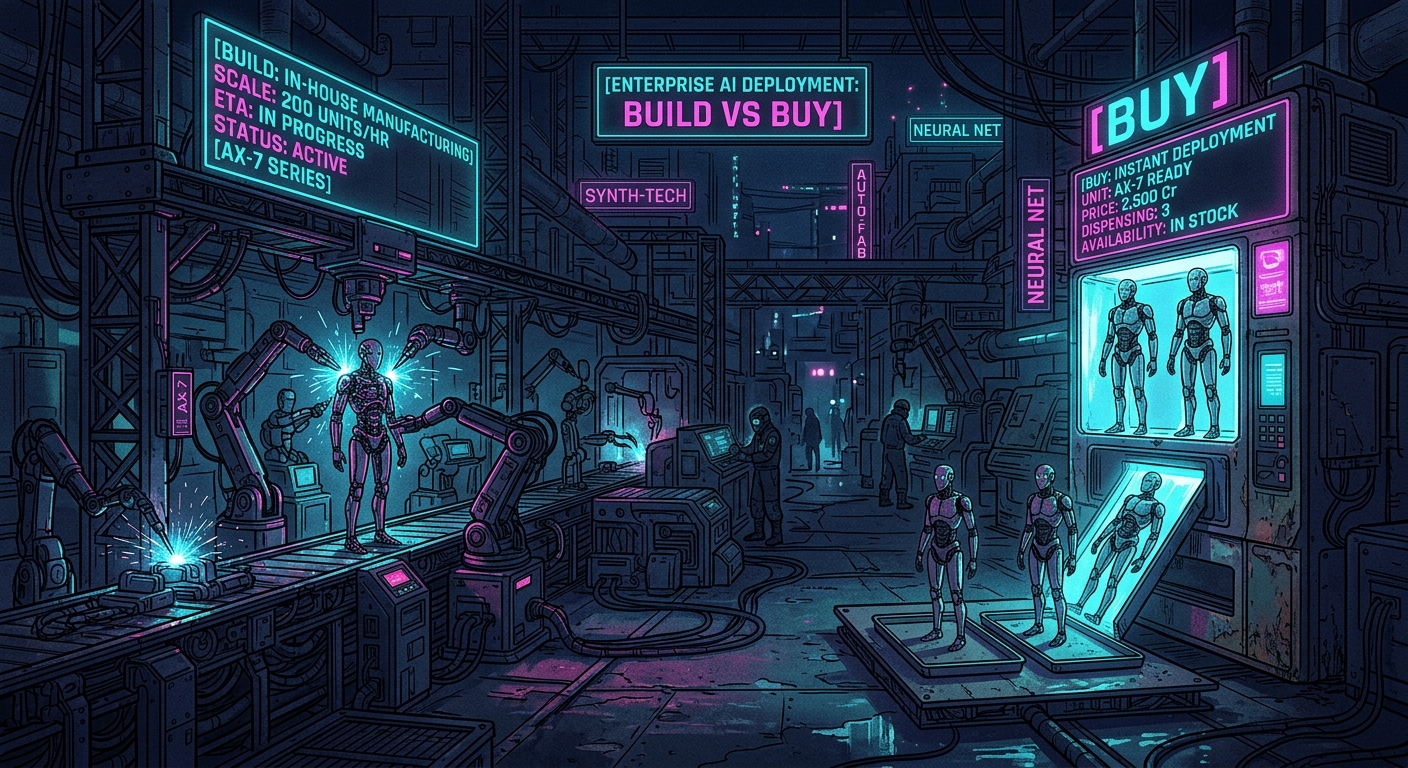
The Most Expensive Instinct in Enterprise Engineering
Here is a scene I have witnessed at least thirty times in the last two years. A VP of Engineering walks into a planning meeting and says: "We need an AI solution for X." The team evaluates a few vendors, runs a quick proof-of-concept, and then — almost reflexively — decides to build it in-house. The reasoning is always some combination of "we need full control," "our data is unique," and "no vendor can do exactly what we need."
Eighteen months later, the custom solution is half-finished. The original team of three has grown to nine. The ML engineers are spending 70% of their time on data pipelines, not models. The system handles 60% of the use cases the vendor product handled on day one. And the total cost — loaded salaries, infrastructure, opportunity cost — is somewhere north of $2 million.
Meanwhile, the vendor product they dismissed? It shipped twelve new features, onboarded four hundred enterprise customers whose edge cases battle-tested every component, and costs $120,000 per year.
This is the Build Trap. And it is consuming enterprise AI budgets at an alarming rate.
Why the Build Instinct Is Wrong for AI
The instinct to build is not irrational. It comes from two decades of enterprise software where buying meant vendor lock-in, rigid configurations, and painful integration. In the traditional software era, building gave you control, flexibility, and competitive differentiation.
AI is fundamentally different, and the build calculus has inverted.
The data flywheel matters more than your data. The most common justification for building custom is "our data is unique." It almost never is — not in the ways that matter for model quality. A document processing vendor that has processed 500 million invoices across 10,000 companies has a data flywheel your internal team cannot replicate. Their model has seen every edge case: handwritten annotations, multi-currency invoices, damaged scans, tables that span pages. Your internal training set of 50,000 invoices from one company produces a model that works on your invoices and fails spectacularly on anything slightly different.
The maintenance burden is non-linear. Building an ML model is maybe 20% of the total effort. The other 80% is monitoring for drift, retraining pipelines, evaluation infrastructure, edge case handling, scaling, and the silent failures that plague every production AI system. We wrote extensively about why evaluation is harder than building — and most teams that choose to build have not even begun to account for this cost. A vendor amortizes this maintenance across their entire customer base. You bear it alone.
The talent cost is catastrophic. ML engineers capable of building production AI systems cost $250-400K fully loaded. For a custom document processing system, you need at minimum two ML engineers, one data engineer, one infrastructure engineer, and half a product manager. That is $1.5M per year in talent alone — before infrastructure, before tooling, before the retraining cycles. For a problem that a $100K/year SaaS product has already solved.
The time-to-value gap is fatal. Your custom build ships in 12-18 months if everything goes well. The vendor product ships in 2-4 weeks. In a market where AI capabilities are evolving quarterly, spending 18 months building what already exists is not engineering — it is competitive suicide.
The Categories Where Buying Wins — Every Time
Not every AI problem has a product solution. But far more do than most engineering leaders realize. Here are the categories where I have seen custom builds fail repeatedly against existing products.
Document Processing and Extraction
This is the single most over-built category in enterprise AI. Companies are spending millions building custom OCR, document classification, and data extraction pipelines when products like AWS Textract, Google Document AI, and dozens of specialized vendors have solved this at a level of quality and scale that no internal team can match.
The tell: your ML team has spent three months trying to get table extraction accuracy above 90%. The vendor product hit 97% two years ago because they have processed billions of tables across every document format that exists.
Search and Knowledge Retrieval
Every enterprise wants "AI-powered search over our internal documents." The default instinct is to build a custom RAG pipeline: embed the documents, stand up a vector database, write retrieval logic, build a generation layer. Six months later, the team has reinvented a worse version of what Glean, Coveo, or Elastic's AI search provides out of the box.
The custom RAG pipeline also creates the exact architectural debt we described in our analysis of why RAG-first architectures fail at scale. You are not just building a search system — you are committing to maintain an entire knowledge infrastructure stack.
Transcription and Speech Processing
I have seen three separate enterprises in the last year with teams of 4-6 engineers building custom speech-to-text systems. In every case, the accuracy was worse than Deepgram, AssemblyAI, or even OpenAI's Whisper API. Speech processing has massive scale advantages — the vendors have trained on millions of hours of audio across accents, noise conditions, and domains. Your 10,000 hours of internal meeting recordings produce a model that works in your conference rooms and nowhere else.
Qualitative Research and Analysis
This is a category where the build trap is particularly painful because the problem looks deceptively simple. "We just need to analyze survey responses" or "we need to code interview transcripts." Teams build custom NLP pipelines with entity extraction, sentiment analysis, and theme clustering — and end up with something fragile, hard to maintain, and less capable than purpose-built tools.
Products like Qualz.ai are reshaping how qualitative analysis works by combining AI with researcher workflows in ways that custom builds never achieve. The specialized tooling understands the research process, not just the text processing. The same principle applies to research repositories that teams actually use — the product thinking around workflow integration is as important as the AI, and it is the part that custom builds consistently miss.
Content Moderation and Safety
Every platform team thinks their content moderation needs are unique. They almost never are. The patterns of toxic content, spam, and policy violations are remarkably consistent across contexts. Building custom moderation means building custom evaluation, custom edge case handling, and custom adversarial testing — work that specialized vendors have invested thousands of engineering hours into.
Anomaly Detection and Monitoring
"Our systems are unique, so we need custom anomaly detection." This is the refrain I hear most from infrastructure teams. In practice, the underlying statistical patterns of system anomalies are well-understood, and products like Datadog's AI monitoring, Anodot, or New Relic's AIOps handle 90% of use cases better than custom-built solutions because they have been trained on telemetry from thousands of production environments.
The Real Decision Framework
I am not arguing that enterprises should never build custom AI. There are legitimate cases. But the decision framework most organizations use — "can any vendor do exactly what we need?" — is the wrong question. The right question is a sequence of four evaluations.
1. Is This a Differentiating Capability?
If the AI capability directly creates competitive advantage — it is your core product, it embodies proprietary methodology, it operates on genuinely unique data that no vendor could access — then building is justified. A hedge fund's alpha-generating trading models should be built in-house. A law firm's document processing should not.
The test is brutal and honest: if your competitor could buy the same vendor product and achieve 80% of your capability, it is not differentiating. Build the 20% that is.
2. What Is the Total Cost of Ownership Over Three Years?
Most build-vs-buy analyses compare Year 1 costs. This is deceptive. The vendor cost is roughly linear — $100K this year, $100K next year, $100K the year after. The build cost is front-loaded in construction and then accumulates maintenance: Year 1 is $1.5M to build, Year 2 is $800K to maintain and iterate, Year 3 is $600K to keep it running and handle drift. Total: $2.9M versus $300K.
Include in your build estimate: hiring and retention risk (what happens when your two ML engineers leave?), infrastructure costs, evaluation and monitoring infrastructure, retraining cycles, and the opportunity cost of what those engineers could have built instead.
3. How Fast Is the Domain Evolving?
AI capabilities are advancing on a quarterly cadence. If you build a custom solution today, it is built on today's models and techniques. In twelve months, the frontier will have shifted. Vendors track the frontier because their business depends on it. Your internal team — busy maintaining the existing system — does not.
I have seen custom solutions built on GPT-3.5 architectures that were already obsolete before they shipped to production. The vendor equivalent had already migrated to GPT-4 and was testing Claude integration.
4. What Is Your Engineering Capacity Costing You Elsewhere?
This is the question that kills the build argument in most cases. Your ML engineers are a finite, expensive resource. Every engineer building a custom document processor is an engineer not building the AI capabilities that actually differentiate your business. The opportunity cost is not theoretical — it is the product features that do not ship, the competitive advantages that do not materialize, and the innovation that does not happen.
The Hybrid Path: Buy the Platform, Build the Edge
The most effective enterprise AI strategies I have seen follow a clear pattern: buy the 80% that is commodity, build the 20% that is proprietary.
Concretely, this means:
Buy the infrastructure layer. Model hosting, vector databases, evaluation frameworks, monitoring — these are solved problems. Do not build them. Use them.
Buy the capability layer for non-differentiating use cases. Document processing, search, transcription, moderation, basic analytics — buy these as products. Integrate them via APIs. Move on.
Build the intelligence layer that is uniquely yours. The domain-specific reasoning, the proprietary workflow automation, the custom decision logic that encodes your competitive advantage — this is where your ML engineers should spend their time. Build what makes you different. Buy everything else.
Invest in integration, not reinvention. The engineering skill that matters most in enterprise AI is not model training — it is systems integration. The ability to wire vendor AI products into your existing workflows, data systems, and business processes. This is hard engineering work. It is also far more valuable than rebuilding what vendors have already built.
The audit trail and explainability requirements for enterprise AI are a perfect example of where this hybrid approach works. Buy the AI capability. Build the governance and compliance layer around it. The governance layer is where your industry-specific requirements live. The AI capability itself is commodity.
How We Think About This at Bigyan
Our advisory practice exists specifically because the build-vs-buy decision is the highest-leverage choice in enterprise AI strategy — and it is the one most organizations get wrong.
We have audited custom AI projects with $3M in sunk costs that should have been $150K vendor contracts. We have also stopped companies from buying vendor products that genuinely could not meet their requirements, saving them from a different kind of trap — the integration nightmare of forcing a product into a use case it was not designed for.
The pattern we follow:
Capability mapping. We map every AI use case in the organization against the vendor landscape. Not just "does a vendor exist?" but "does a vendor exist that meets 80% of requirements at 20% of the build cost with acceptable integration complexity?"
Build-only justification. For any use case where the team wants to build, we require a written justification that addresses all four evaluation criteria: differentiation, three-year TCO, domain evolution rate, and opportunity cost. If the justification does not survive scrutiny, the answer is buy.
Vendor architecture review. For use cases where we recommend buying, we design the integration architecture — how the vendor product fits into existing systems, what the data flows look like, where the governance layer wraps around it, and what the migration path looks like if the vendor relationship changes.
Build architecture for the 20%. For the genuinely differentiating use cases, we design the custom AI architecture with production readiness from day one — not a prototype that will need to be rebuilt, but infrastructure that scales.
The Uncomfortable Truth
The build trap persists because it flatters engineering organizations. Building custom AI feels like innovation. Buying a vendor product feels like giving up. Engineering leaders are promoted for ambitious builds, not prudent purchases.
But the enterprises that are actually winning with AI — the ones shipping capabilities at speed, keeping costs under control, and maintaining systems that work — are the ones that had the discipline to buy what is commodity and focus their engineering talent on what is genuinely theirs.
The build trap is not a technology problem. It is a culture problem. And solving it requires engineering leaders who are secure enough to say: "This problem is already solved. Let us go solve one that is not."
Bigyan helps enterprises make the right build-vs-buy decisions for AI. We have seen both sides of the trap — and we know which problems are worth your engineering talent. Talk to us about your AI strategy.
Founder & Principal Architect
Ready to explore AI for your organization?
Schedule a free consultation to discuss your AI goals and challenges.
Book Free Consultation