Backpressure Patterns for AI Agent Systems: Why Unbounded Queues Kill Production Reliability
Your agent system accepts requests faster than it can process them. Without backpressure, queues grow until memory explodes, latency becomes unbounded, and your users experience cascading failures that look like bugs but are actually architecture problems.
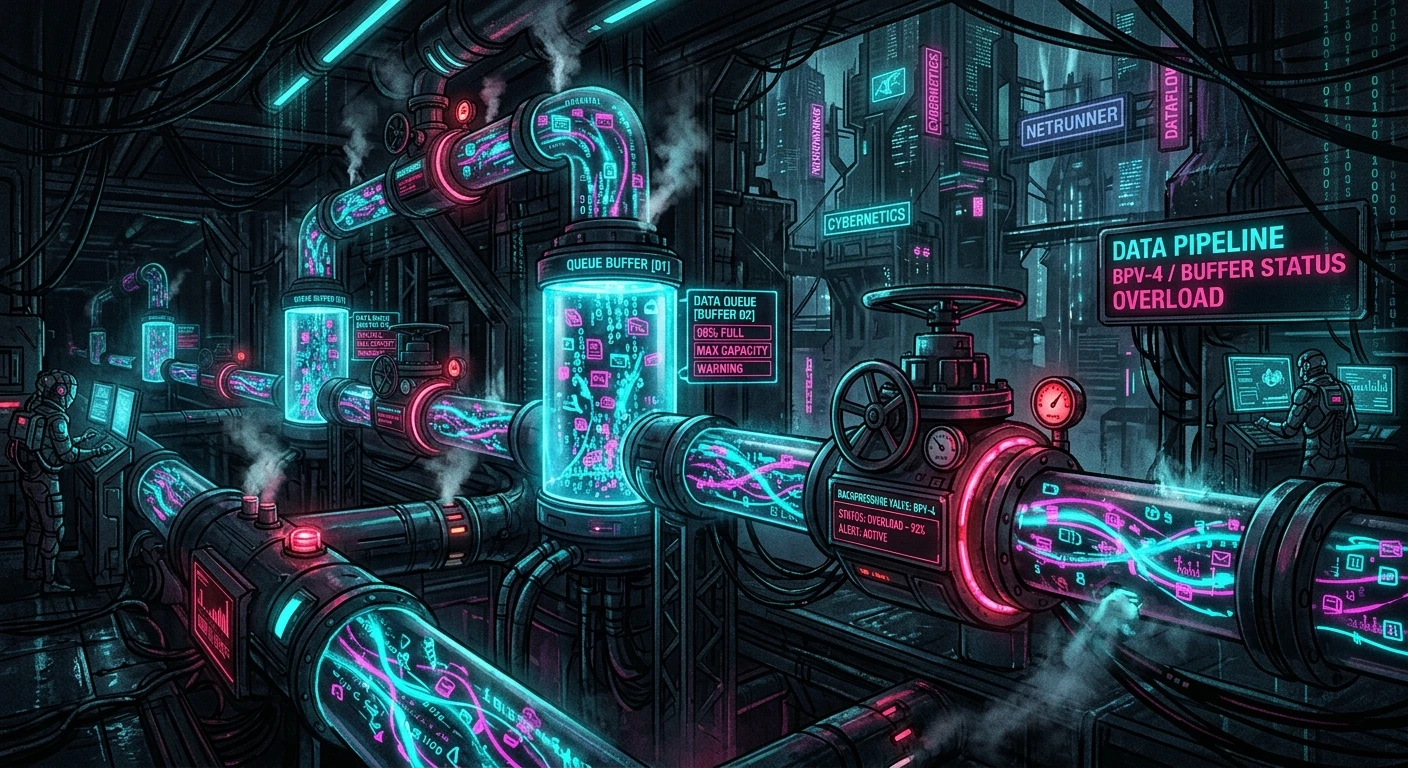
The Queue That Ate Production
Every AI agent system has an implicit queue somewhere. Requests come in from users, upstream services, or scheduled triggers. The agent processes them -- calling models, executing tools, writing results. When inflow exceeds processing capacity, that implicit queue grows. And in most production agent systems, nothing stops it from growing until the system falls over.
This is the backpressure problem, and it is the single most common cause of production outages in agent systems that work perfectly in development and staging. The reason is straightforward: development traffic is bursty but bounded. Production traffic is sustained and spiky. The difference between a system that handles 10 concurrent agent sessions and one that handles 1,000 is not better models or faster inference -- it is backpressure engineering.
Teams building multi-agent orchestration systems face this at a multiplied scale. A single user request might fan out to four sub-agents, each making multiple model calls and tool invocations. Without backpressure, one traffic spike cascades through every layer of the system simultaneously.
Why Agent Systems Are Uniquely Vulnerable
Traditional web services have well-understood backpressure patterns: connection pools, thread limits, load balancer health checks. These patterns emerged over two decades of production experience. Agent systems break most of them because of three structural properties:
Variable execution time. A web request takes 50-500ms. An agent execution takes 2-120 seconds depending on the task complexity, number of tool calls, and model latency. This variance makes capacity planning nearly impossible with traditional approaches. You cannot set a fixed concurrency limit when one request takes 3 seconds and another takes 90.
Compound resource consumption. Each agent execution consumes multiple external resources: model API quota, tool execution capacity, memory for conversation state, and downstream service bandwidth. Backpressure must account for all of these simultaneously. A system might have available model quota but be exhausted on tool execution capacity -- and without holistic backpressure, it will accept requests it cannot complete.
State accumulation. Unlike stateless web requests, agent executions accumulate state as they progress. An agent that is 80% through a complex task holds conversation history, intermediate results, and tool call state in memory. Killing it to relieve pressure means losing that work entirely. This makes the circuit breaker patterns more complex -- you cannot simply shed load without consequence.
Four Backpressure Patterns That Work
1. Admission Control With Estimated Cost
The most effective pattern is admission control based on estimated execution cost rather than simple request counting. Before accepting a new agent request, estimate its resource consumption based on the task type, historical execution profiles, and current system state.
Implementation: maintain a "resource budget" that represents your system total capacity across all dimensions (model tokens/minute, concurrent tool calls, memory). Each incoming request gets a cost estimate. If accepting it would exceed the budget, return a 429 with a Retry-After header or enqueue with an explicit position and ETA.
The key insight is that cost estimation does not need to be precise -- it needs to be conservative. Overestimating cost means you reject some requests you could have handled. Underestimating means you accept requests that will degrade the entire system. The asymmetry of consequences makes conservative estimation the correct default.
2. Hierarchical Rate Limiting
Flat rate limits (100 requests/minute) do not work for agent systems because they treat all requests equally. A simple lookup query and a complex multi-step research task consume vastly different resources but count the same against a flat limit.
Hierarchical rate limiting applies different limits at different levels: per-user, per-task-type, per-resource-pool, and globally. A user might be allowed 10 simple queries/minute but only 2 complex research tasks/minute. The global limit might cap total model token consumption regardless of how it is distributed across users.
This connects to cost engineering for LLM applications -- backpressure and cost control are two sides of the same coin. The rate limits that prevent system overload also prevent budget overruns.
3. Priority Queues With Preemption
When you must queue requests, not all requests should wait equally. Priority queues let you ensure that critical operations (user-facing, time-sensitive) proceed while background tasks (batch processing, precomputation) absorb the delay.
The dangerous pattern is priority inversion: a low-priority batch job that started before the spike holds resources that a high-priority user request needs. Preemption -- the ability to pause or checkpoint a low-priority execution and reclaim its resources -- solves this but requires agent architectures that support suspension and resumption.
This is where idempotency patterns become critical infrastructure rather than nice-to-have. If you can safely restart a preempted agent execution from its last checkpoint, preemption becomes a viable backpressure tool. Without idempotency, preemption means lost work and potential side-effect duplication.
4. Adaptive Concurrency Limits
Static concurrency limits are set during deployment and never change. Adaptive concurrency limits adjust based on observed system behavior -- specifically, the relationship between concurrency and latency.
The algorithm is simple: increase concurrency when latency is stable or decreasing; decrease concurrency when latency is increasing. This creates a feedback loop that automatically finds the optimal operating point for current conditions, which may vary by time of day, model provider performance, or downstream service health.
Libraries like Netflix Concurrency Limits implement this pattern for traditional services. For agent systems, the adaptation signal should include not just latency but also model error rates, tool call failure rates, and memory pressure.
The Observability Requirement
Backpressure patterns are useless without observability into queue depth, rejection rates, and resource utilization. The observability challenges for AI systems multiply here because you need real-time signals that drive automated decisions, not just dashboards for humans to watch.
The minimum viable observability for backpressure includes: current queue depth by priority level, admission rate vs. rejection rate over time, p50/p95/p99 execution latency with breakdown by phase (queuing, model inference, tool execution), resource utilization across all constrained resources, and preemption/retry counts.
Without these signals, you are flying blind. You will not know your backpressure is too aggressive (rejecting requests you could handle) or too permissive (accepting requests that degrade quality) until users complain.
Implementation Priorities
If you are building an agent system today, implement backpressure in this order:
- Global admission control with conservative static limits. Ship this before you ship the agent system itself.
- Per-user rate limiting to prevent one user from consuming all capacity.
- Priority queues for when admission control starts rejecting -- ensure critical operations still proceed.
- Adaptive concurrency once you have enough production data to tune the feedback loop.
- Preemption only when your agent architecture supports checkpointing and idempotent resumption.
The organizations that treat backpressure as a production requirement rather than an optimization consistently ship more reliable agent systems. The ones that say "we will add rate limiting later" consistently experience their first major outage within weeks of launch.
Backpressure is not about limiting what your system can do. It is about ensuring your system reliably does what it promises. In agent systems where a single failure can corrupt state, lose work, or produce incorrect results, that reliability guarantee is worth more than raw throughput.
Founder & Principal Architect
Ready to explore AI for your organization?
Schedule a free consultation to discuss your AI goals and challenges.
Book Free Consultation