Graph-Based Agent Memory: Why Vector Search Alone Cannot Power Enterprise AI Workflows
Vector databases gave agents memory. But similarity search without relational structure turns enterprise knowledge into an unnavigable soup. Graph-based memory architectures let agents reason about connections, not just retrieve fragments.
The Memory Problem Nobody Solved
Every enterprise AI team hits the same wall around month three. The proof of concept worked beautifully. The agent answered questions about company documents with impressive accuracy. Leadership signed off on production deployment. Then reality arrived.
The agent that could answer "What is our refund policy?" with perfect precision could not answer "Which policy changes affected the contracts we signed with healthcare clients last quarter?" The first question requires retrieval. The second requires reasoning across relationships -- between policies, contracts, client segments, and time periods. Vector search handles the first case effortlessly. It fails the second because similarity is not the same as connection.
This is the fundamental limitation that graph-based memory architectures address. Not by replacing vector search, but by adding the relational layer that transforms retrieval into reasoning.
Why Vector Search Hits a Ceiling
Vector databases solved a genuine problem. Before embeddings, search was keyword-based -- brittle, literal, unable to handle semantic variation. Vector search introduced meaning-aware retrieval. You embed your documents, embed your query, and find the nearest neighbors in high-dimensional space. For straightforward question-answering over document collections, this works remarkably well.
The ceiling appears when enterprise knowledge is not a flat collection of documents but a web of interconnected entities with typed relationships.
Consider what happens when an agent needs to answer: "Which engineering decisions from the platform migration are creating technical debt in our current sprint?" This question touches architecture decision records, migration planning documents, sprint backlogs, code review comments, and incident reports. The relevant information is not similar in embedding space -- migration planning documents and sprint backlogs have very different vocabulary and semantic signatures. What connects them is a chain of relationships: decisions led to implementations, implementations created dependencies, dependencies are now causing friction.
Vector search retrieves documents that are semantically close to the query. Graph traversal follows the actual relationships between entities regardless of their semantic similarity. Enterprise knowledge is fundamentally relational, which means the most important connections are often between semantically dissimilar pieces of information.
This is not a theoretical concern. Teams building production RAG architecture patterns consistently report that the hardest queries to handle are precisely those that require traversing relationships rather than matching similarity.
The Structure of Enterprise Knowledge
Enterprise knowledge has a natural graph structure that flat document stores obscure. Every organization operates through a network of entities -- people, teams, projects, decisions, documents, systems, clients, contracts -- connected by typed relationships that carry meaning.
A project has an owner. The owner belongs to a team. The team is responsible for a system. The system serves specific clients. Those clients have contracts with particular terms. Those terms were shaped by regulatory requirements. Those requirements changed last quarter.
When you flatten this web into a vector store, you preserve the content of each node but lose the edges that give that content operational meaning. The agent can tell you what any individual document says. It cannot tell you why that document matters in the context of a specific decision, or how a change in one part of the network propagates to another.
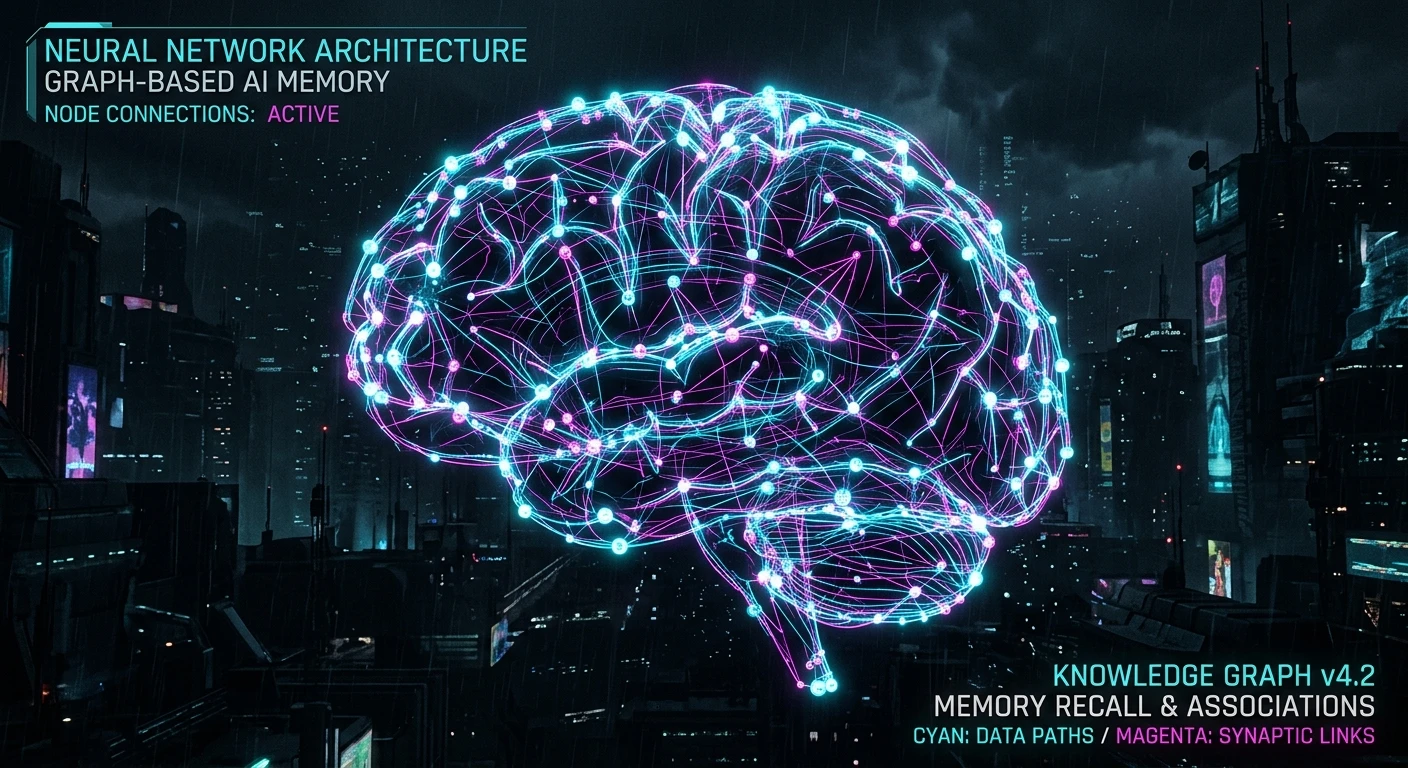
Graph-based memory preserves both the content and the connections. Each piece of knowledge exists as a node with its own embedding and metadata, but it also carries explicit typed relationships to other nodes. The agent can retrieve by similarity when that is appropriate, and traverse by relationship when the question demands it.
How Graph Memory Actually Works in Practice
A practical graph memory architecture for enterprise agents typically combines three layers:
The Entity Layer
The entity layer contains the nodes: documents, people, decisions, events, concepts, and any other discrete unit of knowledge relevant to the domain. Each entity has:
- A unique identifier
- A vector embedding for similarity search
- Structured metadata (type, creation date, source, confidence)
- A natural language summary for LLM consumption
This layer alone is equivalent to a well-structured vector database. The difference is what comes next.
The Relationship Layer
The relationship layer contains typed, directed edges between entities. "authored," "depends_on," "contradicts," "supersedes," "implements," "violated_by" -- these relationship types encode the semantics of how knowledge connects. Each relationship can carry its own metadata: when it was established, by whom, with what confidence, and under what context.
Typed relationships are what enable reasoning. When an agent traverses a "supersedes" edge, it knows that the target node replaces the source node. When it follows a "contradicts" edge, it knows to flag a conflict. When it walks a chain of "depends_on" edges, it can map a dependency tree. None of this is possible with similarity search alone.
The Inference Layer
The inference layer sits on top and handles the reasoning. Given a query, it determines the appropriate retrieval strategy: pure vector search for simple factual questions, graph traversal for relational questions, or a hybrid approach for complex queries that require both.
For a query like "What are the risks of proceeding with the AWS migration given our current team capacity?" the inference layer would:
- Identify relevant entity types: migration plans, team capacity records, risk assessments, dependency maps
- Retrieve starting nodes via vector search on the migration topic
- Traverse relationships to find team assignments, current workloads, and blocking dependencies
- Walk risk-related edges to gather previously identified concerns
- Synthesize a response that incorporates both retrieved content and traversed relationships
The result is not just a collection of relevant paragraphs. It is a structured understanding of how different pieces of knowledge relate to the specific question.
The Ingestion Challenge
Building a graph memory is harder than building a vector store, and most of the difficulty is in ingestion. Vector databases require you to chunk documents and generate embeddings -- a well-understood pipeline. Graph memory requires you to extract entities, identify relationships, and resolve ambiguities -- a fundamentally harder problem.
Entity extraction from unstructured enterprise documents is imperfect. The same person might be referred to as "Sarah," "S. Chen," "the VP of Engineering," and "the migration lead" across different documents. A reliable entity resolution pipeline must handle these variations without creating duplicate nodes or missing connections.
Relationship extraction is even harder. When a document says "The API redesign was motivated by the performance issues identified in the Q3 review," a human reader easily identifies the causal relationship between the Q3 review findings and the API redesign decision. Extracting this relationship programmatically requires understanding causality, temporal ordering, and organizational context.
Modern LLMs have made both tasks dramatically more feasible. An extraction pipeline that uses an LLM to identify entities and relationships from each document, then passes the results through a resolution layer that merges duplicates and validates edges, can build a reasonable knowledge graph from a corpus of enterprise documents in hours rather than months. The accuracy is not perfect, but it is good enough to be useful -- and the graph can be refined incrementally as errors are discovered.
This is where the era of AI engineering becomes tangible. The challenge is not in training models but in building the engineering systems that extract, structure, and maintain knowledge at enterprise scale.
Graph RAG: Retrieval Augmented Generation With Structure
Graph RAG is the retrieval pattern that combines vector search with graph traversal to provide LLMs with structured context. Unlike standard RAG, which retrieves a flat list of relevant chunks, Graph RAG retrieves a subgraph -- a connected set of nodes and relationships that preserves the structure of the relevant knowledge.
The practical difference is significant. Standard RAG might retrieve five document chunks that are each individually relevant to a query. The LLM must then figure out how these chunks relate to each other, which it does through inference rather than evidence. Graph RAG retrieves the same content plus the explicit relationships between the pieces, giving the LLM a map rather than a pile.
Consider how this applies to affinity mapping for qualitative synthesis. In qualitative research, the value is not in individual data points but in the patterns and relationships between them. The same principle applies to enterprise knowledge: the connections are where the insight lives.
A Graph RAG query typically follows this pattern:
- Embed the query and retrieve the top-k similar nodes from the vector index
- For each retrieved node, traverse N hops of relevant relationship types
- Score the traversed nodes by relevance (combining graph distance, relationship type relevance, and optional vector similarity)
- Construct a context window that includes both node content and relationship descriptions
- Pass the structured context to the LLM with a prompt that instructs it to use the relationship information
The context window for a Graph RAG query might look like:
<code>Entity: AWS Migration Plan v3 (Decision Document, 2026-01-15) Content: [document excerpt] Relationships:
- SUPERSEDES: AWS Migration Plan v2 (2025-09-20)
- OWNED_BY: Platform Engineering Team
- DEPENDS_ON: IAM Redesign (Status: In Progress, 60% complete)
- DEPENDS_ON: Data Pipeline Migration (Status: Blocked by vendor)
- RISK_IDENTIFIED: Single point of failure in auth service (Severity: High) </code>
This structured context enables the LLM to reason about the current state of the migration, its dependencies, and its risks -- not by inferring these relationships from document similarity but by reading them directly from the graph.
When Vector Search Is Enough
Graph memory is not always the right answer. For many enterprise AI use cases, a well-implemented vector store is sufficient and significantly simpler to build and maintain.
Internal knowledge bases and FAQs -- where users ask factual questions about company policies, procedures, and products -- work well with pure vector search. The questions are typically answerable from a single document or a small set of semantically similar documents.
Customer support agents that handle common inquiries can operate effectively with vector retrieval over a well-maintained knowledge base. The queries are usually self-contained, and the answers do not require traversing relationships between different types of knowledge.
Code documentation assistants that help developers find relevant documentation, examples, and API references are natural fits for vector search. The relationship between a query and the relevant documentation is primarily semantic.
The graph becomes necessary when:
- Questions require reasoning across multiple entity types
- The answer depends on the relationships between pieces of knowledge, not just the content
- Temporal reasoning is required (what changed, what superseded what, what was the state at a given time)
- The knowledge base contains contradictions that must be resolved through provenance and recency
- Agents need to plan multi-step actions that depend on the current state of interconnected systems
Building Toward Stateful Agent Architectures
Graph-based memory is one component of a broader architectural shift toward stateful memory architectures for enterprise agents. As agents move from single-turn question answering to multi-step workflow execution, they need memory systems that can track state, maintain context across interactions, and reason about how their actions change the knowledge landscape.
A stateful agent operating on a knowledge graph can:
- Record its own actions as new nodes and relationships
- Track how its outputs were received and used
- Identify when its knowledge is stale and needs updating
- Reason about the consequences of proposed actions by traversing dependency chains
- Maintain conversation context as a subgraph that grows with each interaction
This is fundamentally different from the stateless retrieval pattern where each query is independent. Stateful graph memory gives agents something closer to institutional knowledge -- not just the ability to find information, but the ability to understand how information connects, changes, and matters.
The Path Forward
The enterprise AI landscape is moving from flat retrieval to structured reasoning. Vector databases were the necessary first step -- they proved that semantic search could make unstructured enterprise knowledge accessible to AI agents. Graph-based memory is the next step, adding the relational structure that transforms accessible knowledge into navigable knowledge.
The teams that will build the most capable enterprise agents are not the ones with the best models or the largest context windows. They are the ones that invest in knowledge architecture -- the careful work of extracting, structuring, and maintaining the web of relationships that gives enterprise knowledge its meaning.
Vector search alone cannot power enterprise AI workflows for the same reason that a search engine alone cannot replace understanding a subject. Finding relevant information is necessary but not sufficient. Reasoning about how that information connects, conflicts, evolves, and applies to specific situations is where enterprise value actually lives. Graph-based memory is how we get there.
Founder & Principal Architect
Ready to explore AI for your organization?
Schedule a free consultation to discuss your AI goals and challenges.
Book Free Consultation